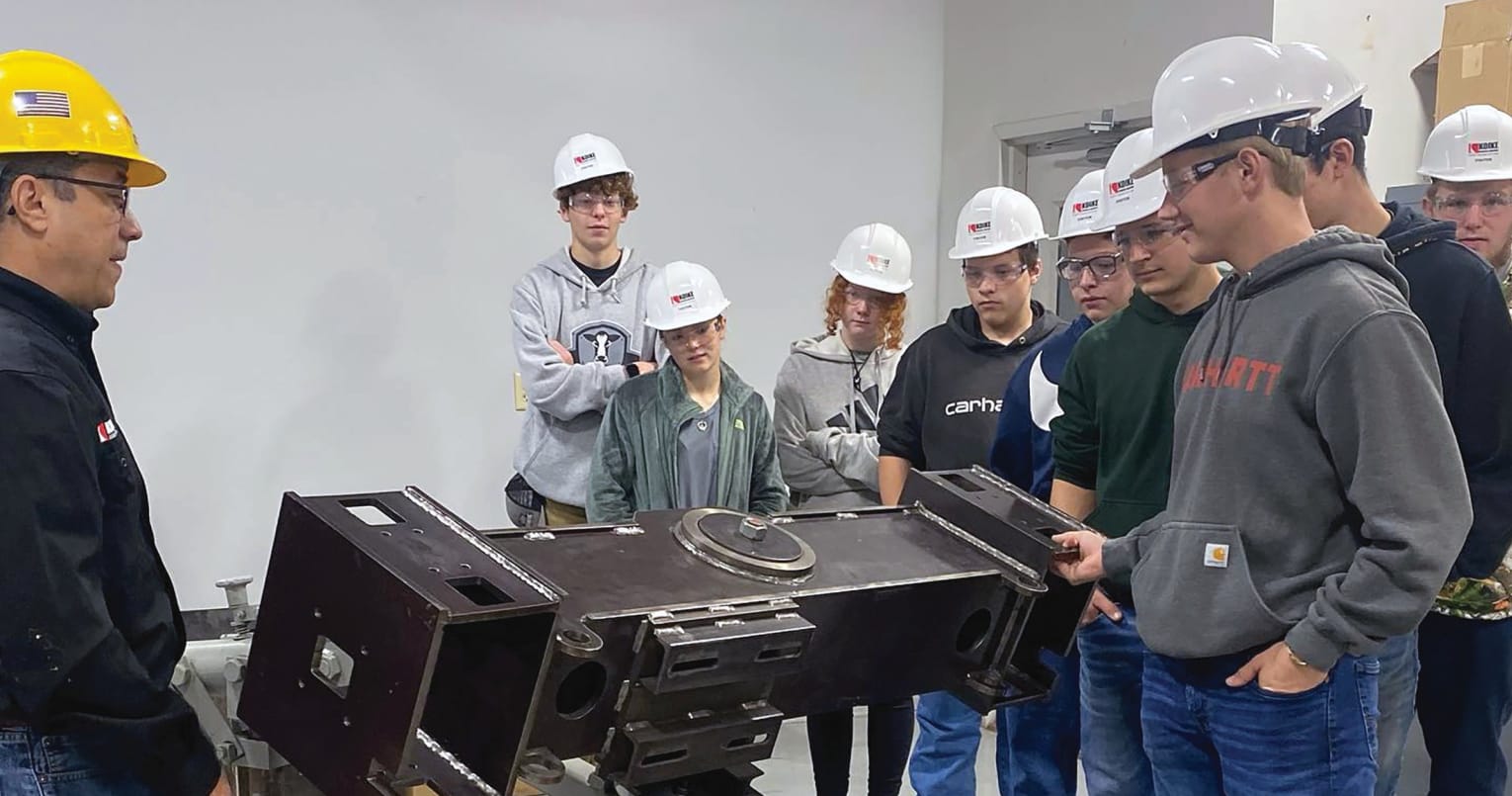
For new welders and welding students, the transition from learning how to run a straight bead to performing fit-up and fabrication work introduces a whole new set of challenges. Heavy weldments and oversized components require additional considerations before welding begins. Knowing how to assess the weight, plan the movement, and use the right equipment is just as important as the weld itself. Gaining proper access to weld joints often requires moving or repositioning the weldment, whether to reach inside corners, complete underside welds, align parts accurately during fit-up, or place the joint in a more favorable 1G flat-weld position.
Why Positioning Is a Challenge for New Welders
New welders often try to “just move it real quick,” not realizing that most shop accidents stem from that exact mindset. Every year, improper lifting practices lead to injuries, downtime, and costly mistakes. For welders and fabricators, the risk is even greater; the materials are not only heavy but often sharp, unbalanced, and difficult to control. Weldments can be heavier than they appear, and when they are moved without proper planning or support, they may shift or fall unexpectedly. Understanding weldment positioning safety before welding and recognizing the hazards is a critical part of developing safe welding and fabrication skills.
Without experience, welders may rely on brute force or instinct rather than planning the move. Determining the weight, size, and center of gravity (CG) of the weldment allows the welder to choose the correct lifting method, attachment points, and equipment.
Safer Lifting with the Right Equipment — Hand lifting should be the last resort. Shops provide tools to specifically reduce injuries and improve control.
Overhead Cranes and Hoists — Cranes and hoists are used on weldments weighing hundreds to thousands of pounds, enabling controlled vertical lifting with slings and rigging hardware.
Forklifts and Carts — Forklifts and carts are helpful for staging or transporting material at working height, reducing the number of manual lifts.
Slings, Hooks, and Rigging Hardware — Selecting proper hardware requires understanding of load angles, CG, and hardware capacity, which is critical knowledge for every welder. Proper planning, communication, and hazard recognition remain essential even with mechanical lifting.
Understanding the Weight and the Risk
To calculate the weight of a steel plate, start by finding its volume and then multiplying it by the density of steel. Steel weighs approximately 0.2836 lb/in.3 (steel density).
Example: Fabricate a six-sided steel box using 1/2-in.-thick by 10-in.-wide by 10-in.-long pieces.
Step 1
Calculate volume: 0.5 × 10 × 10 in. = 50 in.³ (thickness × width × length)
Calculate the weight of each part: 50 × 0.2836 lb = 14.18 lb (weight = V × steel density)
We now know that each piece weighs just over 14 lb. While relatively light compared to the finished box, a piece of this weight falling from a table can easily break a toe, highlighting the need for proper personal protective equipment (PPE), such as safety shoes with metatarsal protection.
Step 2
Calculate the total weight of the box: 6 × 14.18 lb = 85.08 lb
What began as six individual 14-lb pieces became an 85-lb steel box. This is far more likely to cause an injury if lifted incorrectly or it falls.
The Center of Gravity
The CG is the single, imaginary point where an object’s entire weight is concentrated, acting as its balance point. If the CG isn’t identified, or at least estimated before lifting, the weldment can rotate, tip, or swing as soon as it leaves the ground.
Building Safe Habits Early with Welding Positioners
A smart way to introduce safe material-handling concepts is by letting new welders experience CG behavior before they’re anywhere near heavy weldments. A benchtop welding positioner is ideal for this type of training.
By practicing with small assemblies, students quickly learn how:
Off-center loads cause sudden rotation
A part “seeks” its heaviest point
Clamping and fixturing affect stability
Subtle changes in orientation shift balance
Controlled rotation feels when the load is centered properly
These harmless demonstrations build intuition. When a small part snaps toward its heaviest side on a benchtop positioner, the student sees the same forces that act on a 500-lb or 5000-lb workpiece, without the hazards. It reinforces the fundamental rule of rigging and positioning: gravity always wins.
This early experience helps welders develop the awareness needed to operate large positioners and lift devices safely and confidently.
Why Welding Positioners Make Sense for Safety and Efficiency
After all the time and effort spent moving weldments, the value of a welding positioner becomes obvious. Instead of wrestling with material, welders simply rotate the part into the best orientation. Advantages include the following:
Increased safety — resulting in far fewer chances for strains, sprains, and pinch-point injuries.
Better weld quality — more work can be done in ideal 1G conditions.
Higher productivity — no constant re-rigging, re-lifting, or repositioning, with reduced welding wire usage and fewer starts and stops.
Consistent control — stable rotation and fixturing reduce distortion and fatigue.
Faster training for new welders —they can focus on technique, not contortions.
In any shop where safety, consistency, and efficiency matter, welding positioners are far more than a convenience. They’re a critical part of responsible welding practice.
Conclusion
Take the time to search online for more information using the keywords “free rigging handbook,” and don’t be afraid to ask a more experienced welder or fabricator for help.
Positioning weldments safely is a foundational skill for every welder. Whether the load weighs 50 lb or several thousand, improper handling can lead to serious injuries and costly accidents. Tools like cranes, slings, and forklifts reduce risk, but training begins on a much smaller scale. Benchtop welding positioners help new welders understand balance and CG early, building instincts that carry over into handling full-size weldments.
Full-size welding positioners then complete the picture by improving safety, speeding production, and helping welders deliver better results with less effort. In the end, they are among the smartest investments a shop can make, especially for developing welders still learning the craft.
Reprinted with permission: The AWS Welding Journal
Caption for the photo - A demonstration showing welding students how to safely manipulate a 600-lb weldment using a welding positioner.